



(Essay Version)
“The main thing, however, is the algorithm.” “Any child knows that! What’s a beast without an algorithm?” — Stanisław Lem, The Cyberiad.
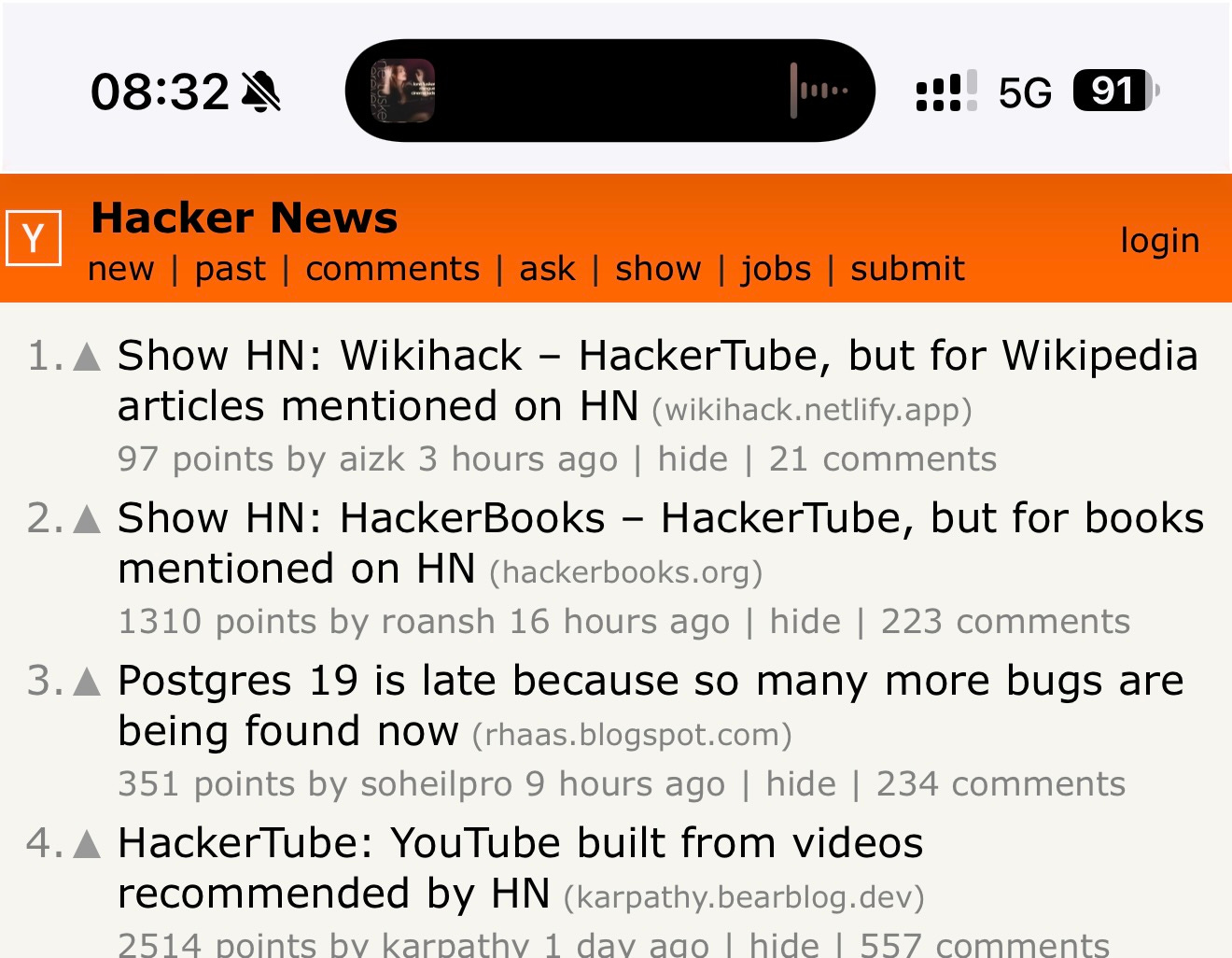
Over the weekend, Andrej Karpathy released HackerTube, and it seemed to take over my entire timeline. He asked Claude Opus 5.5 to build a YouTube library from videos recommended in Hacker News comments. It attracted thousands of points on Hacker News, the launch post seen by almost 4m people.
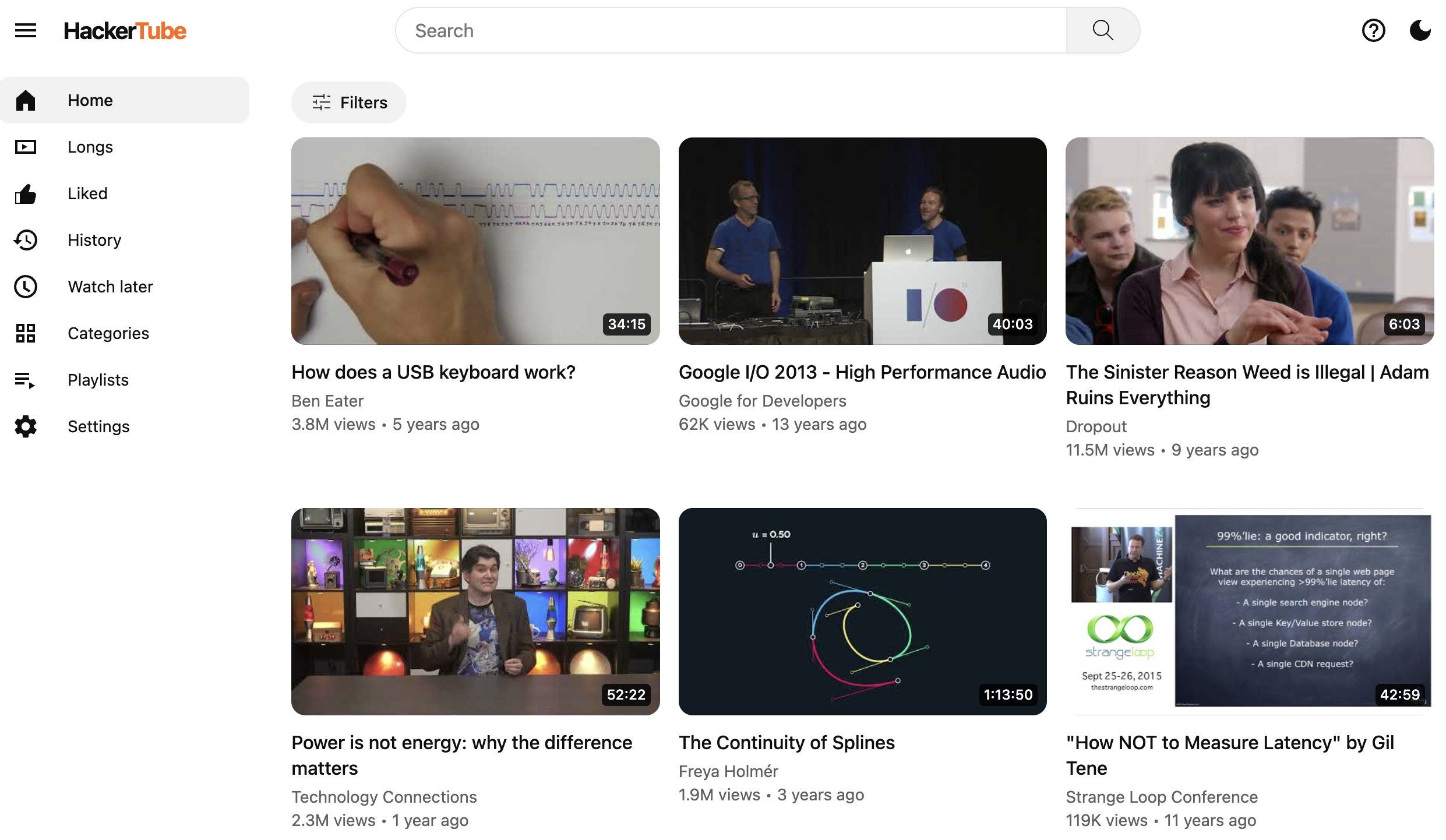
I find it fascinating that something like this can now be built so simply. But this traction also speaks to a yearning for better control over how we spend our time and how we discover new content. We are overwhelmed by what is out there. Finding something worth our attention is still surprisingly difficult.
My experience of YouTube is that I regret much of the time I spend there. Every so often, I come across a video and think: oh my God, this was so good. I had forgotten how amazing the content on here can be. But that is the exception. Most of the time, it’s a waste of time.
In my mind, this comes down to the algorithm and its incentives. YouTube is clearly incentivized to optimize time spent rather than quality time spent. Attention is all they need.
On Spotify, I somehow feel much better about it. It surfaces audiobooks I want to listen to and finds new songs I love. Even random German lofi Rap Pop that I am into. A big part of this is incentives. Spotify seems to care about genuinely serving the absolute best song to me.
HackerTube suggests there is a substantial appetite for another way of filtering content. It also suggests that a simple curatorial rule can sometimes feel better than an extremely complex recommendation system. Its basically >if recommended on hn, show.
It quickly inspired other projects: HackerBooks, collecting books mentioned on Hacker News, and Wikihack, collecting Wikipedia articles linked to there. Each uses the community as a filter.
I think a community filter does have a limit. It gives me a particular world to explore, but will it take me into new worlds? A great recommendation algorithm should also be able to take me into the unknown. I will be a super user of Hackertube but it made me think what more is possible.
Agentic Curation:
That is why I have been thinking about agents as our new algorithms: personal curators that help us decide what to read, watch and listen to. I use agents for all sorts of things, from analysing companies and researching ideas to planning holidays and finding new subjects to explore. With useful memory, they should have a good understanding of me. In principle, that could let them make recommendations aligned with what I want.
I began experimenting with this a couple of weeks ago, when I started the Bradbury challenge: reading a poem, a short story and an essay each evening before sleep, alongside the practice of writing short stories. The idea is to draw from different fields and interests, feeding the subconscious with ideas in different styles.
I used Instinct for this. I gave it the kinds of stories and poetry I typically like, and asked it to use those as a starting point: curate a poem, a story and an essay each day, message me the links, and put them into a database. Every evening, I get three things to read. It has been brilliant. I have discovered interesting authors and ideas that were new to me.

So when I saw HackerTube, I wondered whether my agents could become my algorithm more generally. I mainly use them in different areas and each has a different history with me. I use Hermes, mainly with Opus 5.5 and occasionally DeepSeek; I use a lot of Codex; and I also use Instinct and Hark. They do not have access to the same data, and I use them for quite different use cases.
I gave all of them the same prompt: “Based on your knowledge about my interests and me, can you recommend three YouTube videos that will blow me away and change my perspective?”
The results did blow me away.
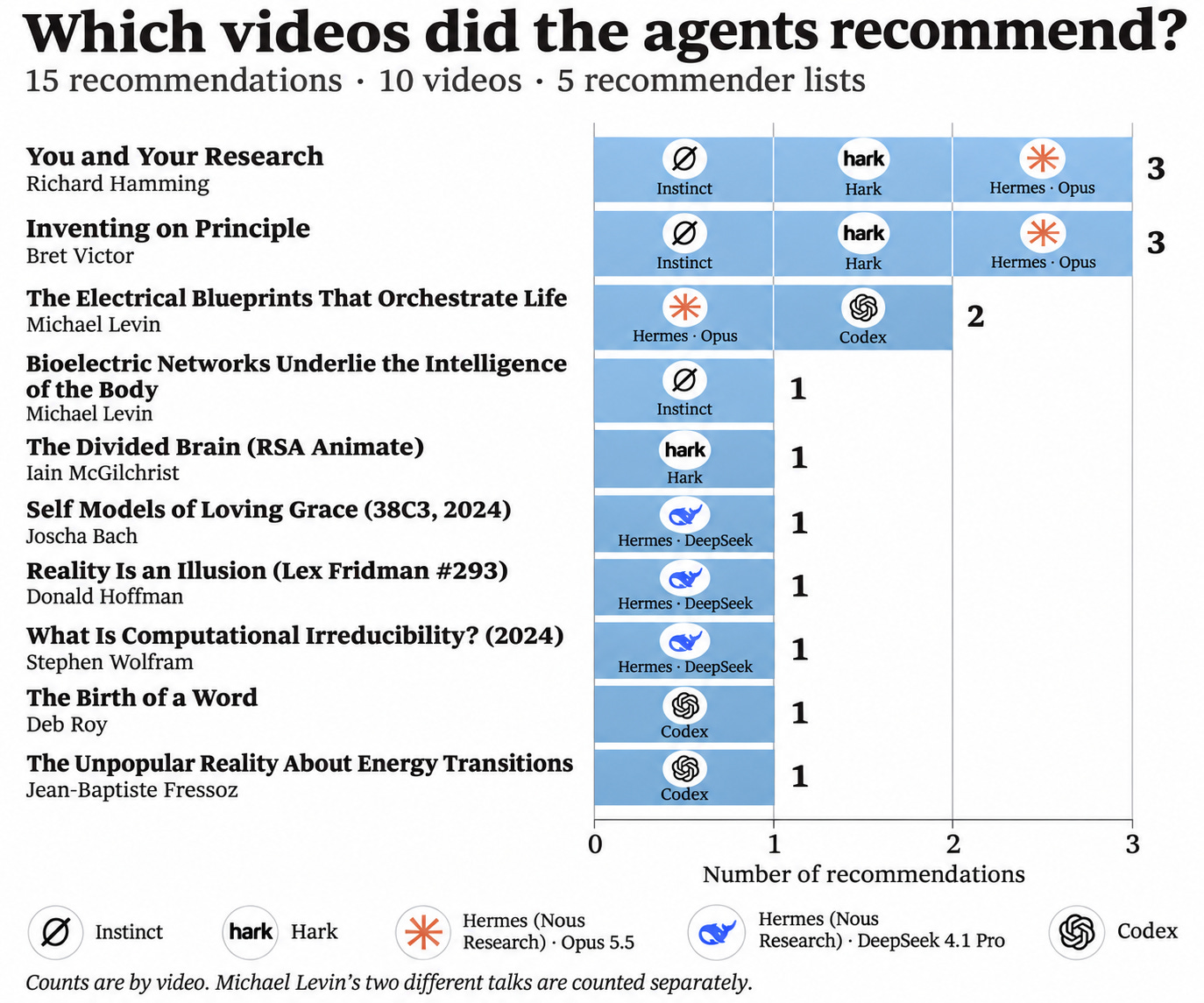
Instinct, Hark and Hermes with Opus all recommended Richard Hamming’s You and Your Research and Bret Victor’s Inventing on Principle. Opus and Codex also recommended Michael Levin’s The Electrical Blueprints That Orchestrate Life. There were other suggestions, but I did not expect any overlap in recommendations. These agents had encountered quite different parts of my life and interests, yet several arrived at the same videos out of 30 billion videos on Youtube. Astra and Opus recommended the same video. On a purely statistical basis assuming a random draw the probability of this happening is mathematical tiny.
I have already watched Inventing on Principle and absolutely loved it. It felt like really unique and I am still thinking about the core ideas.
It will take some work to make agents really good at this. At the very least, there is a feature here for the providers. There may also be a product: a recommendation agent that understands your taste and helps you explore beyond it. In principle, it could serve your needs without needing you to spend longer on YouTube or steering you towards a particular book. It should be perfectly aligned with you.
I believe there will be a significant market for personal recommendation engines and Agentic Curation: algorithms that we can own and tune ourselves. That could be a major source of value for consumers, giving us more control over what we discover and how we spend our time.
Disclosure on AI use:
Codex used to turn podcast to structured esssay.
Cover art and graph generated use imagegen 2.5.
Recommended Video Links by number of recommendations:
Richard Hamming — You and Your Research
Bret Victor — Inventing on Principle
Michael Levin — The Electrical Blueprints That Orchestrate Life
Michael Levin — Bioelectric Networks Underlie the Intelligence of the Body
Iain McGilchrist — The Divided Brain (RSA Animate)
Joscha Bach — Self Models of Loving Grace (38C3, 2024)
Donald Hoffman — Reality Is an Illusion (Lex Fridman #293)
Stephen Wolfram — What Is Computational Irreducibility? (2024)
Deb Roy — The Birth of a Word
Jean-Baptiste Fressoz — The Unpopular Reality About Energy Transitions

